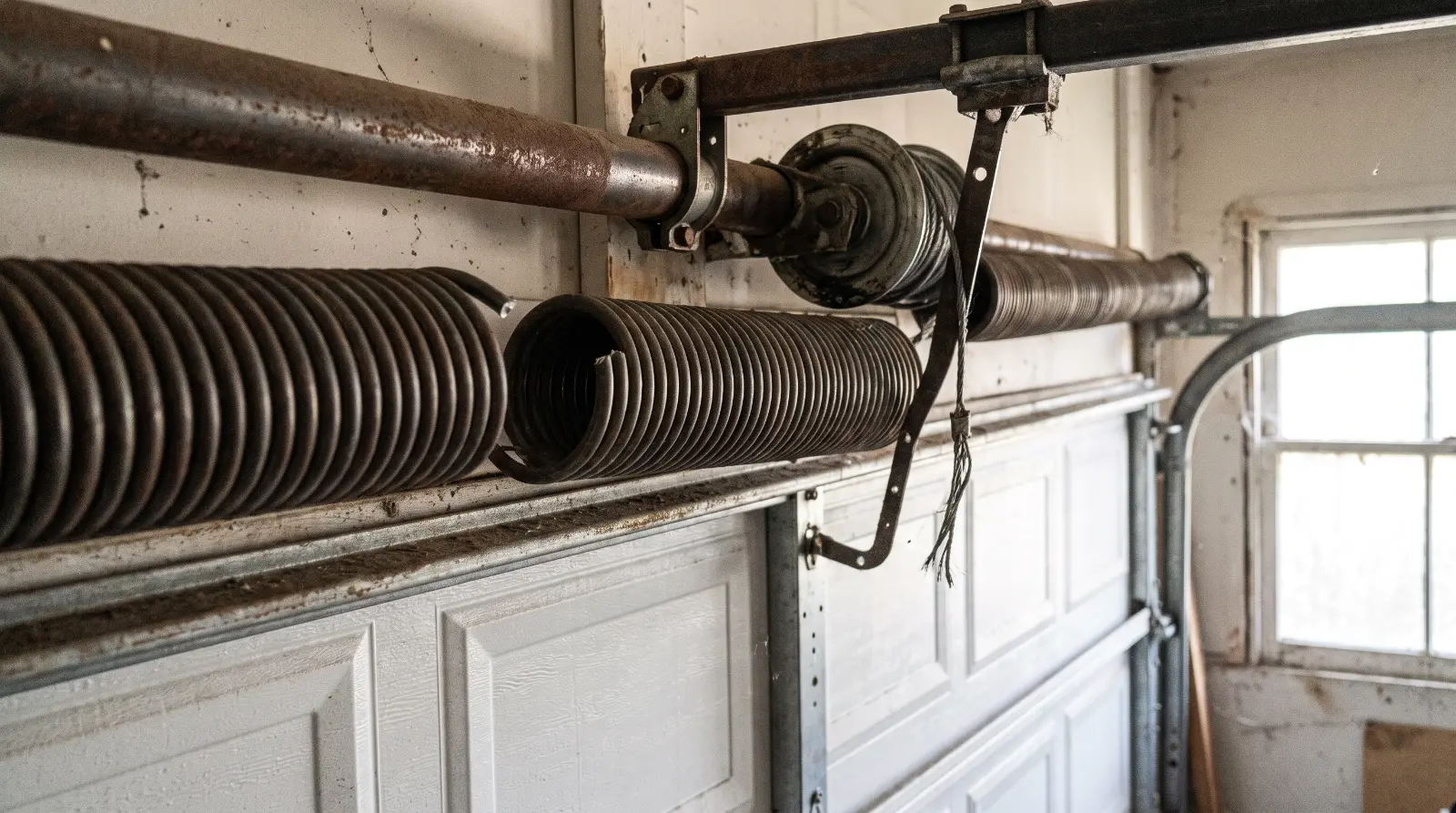
Garage door springs do the heavy lifting. A typical two-car steel door weighs somewhere around 150 to 200 pounds, and an older wood door can weigh a lot more. The springs counterbalance that weight so the opener, or your arm, only has to guide the door. When a spring breaks, the door suddenly weighs everything it really weighs.
If you think a spring has broken: stop using the opener, don't lift the door by hand, and keep kids and pets out of the garage. A spring repair is not a do-it-yourself job. Wound torsion springs store enough energy to break bones.
How to tell a spring is broken
- A bang like a gunshot or a firecracker from the garage, often when nobody is using the door. Springs usually break while the door is closed, because that's when they're under the most tension.
- A gap in the coils. Look at the spring on the bar above the door. A broken torsion spring has a clean gap, often two inches or more, somewhere along its length.
- The opener strains, lifts a few inches and stops, or the door goes up crooked.
- The door feels like a dead weight if it has been released from the opener.
- Cables look loose or have come off their drums at the top corners of the door. When a spring lets go, the cables often lose tension too.
Torsion springs and extension springs
Most Cranston garages have one of two systems, and it helps to know which one you have before you call.
| Type | Where it is | Common in |
|---|---|---|
| Torsion | On a steel bar directly above the door, one or two springs | Most doors installed or replaced since the 1990s, newer homes in Western Cranston |
| Extension | Long springs running alongside the horizontal tracks, one on each side | Older single-car doors, including many detached garages in Edgewood, Knightsville and Garden City |
Extension springs should have a safety cable running through the middle of each spring. If yours don't, a breaking spring can whip across the garage. That's worth mentioning to the technician, who can usually add safety cables during the repair.
Why springs break, and why more of them break in Cranston winters
Every spring is rated for a number of cycles, one cycle being one open and one close. Standard springs are commonly rated for around 10,000 cycles. A household that uses the garage door as the front door, four or five times a day, uses that up in roughly six or seven years. Then the spring fails, usually at the end of a cycle and often on a cold morning.
Cold makes it worse. Steel is less forgiving at low temperatures, and a spring near the end of its life tends to give out on the first hard freeze. Rhode Island winters swing back and forth across freezing all season, and every swing adds stress.
Then there's rust. Homes near the bay and the Pawtuxet River live with damp, salty air, and a spring that's coated in rust has more friction between its coils every time it winds and unwinds. If you can see orange on your springs, they're working harder than they should. Our salt air and rust guide covers what you can do about it.
Spring snapped and the car's inside? Call and tell the company that up front.
Call (401) 498-DOORWhat a spring repair visit usually involves
Every company works a little differently, but a typical visit goes like this:
- The technician confirms which spring broke and checks the cables, drums, bearings and bottom brackets for damage from the break.
- They measure the old spring (wire size, inside diameter and length) or weigh the door, so the new spring is matched to your door.
- They unwind and remove the broken spring using winding bars, then install and wind the new one.
- They balance the door, so it stays put when stopped halfway up, and test the opener's force and reverse settings.
Most spring jobs take an hour or two. If the cables or bottom brackets are badly rusted, which is common near the water, the technician may recommend replacing them on the same visit. Ask them to show you.
Things worth asking
- Should both springs be replaced? If your door has two, they went in together and have done the same work. Many technicians recommend replacing both. Ask what they suggest and why.
- Are higher-cycle springs an option? If the garage is your main entrance, longer-life springs can be worth asking about.
- Is anything else worn? Rollers, cables and bottom brackets often wear out alongside springs.
- What's covered afterward? Ask how long the parts and the work are covered by the company, and get it in writing.
There's a longer checklist on our questions to ask a garage door company page.
What not to do
- Don't keep pressing the opener button. You can strip the opener's gear or bend the top door panel.
- Don't try to lift the door by hand with the release cord pulled. Without the spring, it's far heavier than it looks.
- Don't loosen the set screws on the winding cone or try to unwind the spring yourself.
- Don't use an extension spring that's broken, stretched or missing its safety cable.
Common questions
How long do garage door springs last?
Standard springs are commonly rated for around 10,000 open-and-close cycles. At four or five cycles a day that's roughly six or seven years. Rust and cold winters can shorten that.
Should both springs be replaced at the same time?
If your door has two springs, they're the same age and have done the same work, so when one breaks the other usually isn't far behind. Many technicians replace both on the same visit. Ask what they recommend and why.
Can I replace a garage door spring myself?
We don't recommend it. Torsion springs are wound under enough tension to cause serious injury, and extension springs can whip loose. It's one of the few household repairs where the right tools and training are the whole job.
My car is stuck inside. Can I open the door just this once?
Don't use the opener and don't force the door up by hand. Tell the company on the phone that your car is inside. A technician can usually get the door working on the same visit as the spring repair.
Why did my spring break in the cold?
Steel gets less forgiving as it gets colder, and a spring that's near the end of its life often gives out on the first hard freeze. Rust from damp, salty air makes it worse by adding friction between the coils.