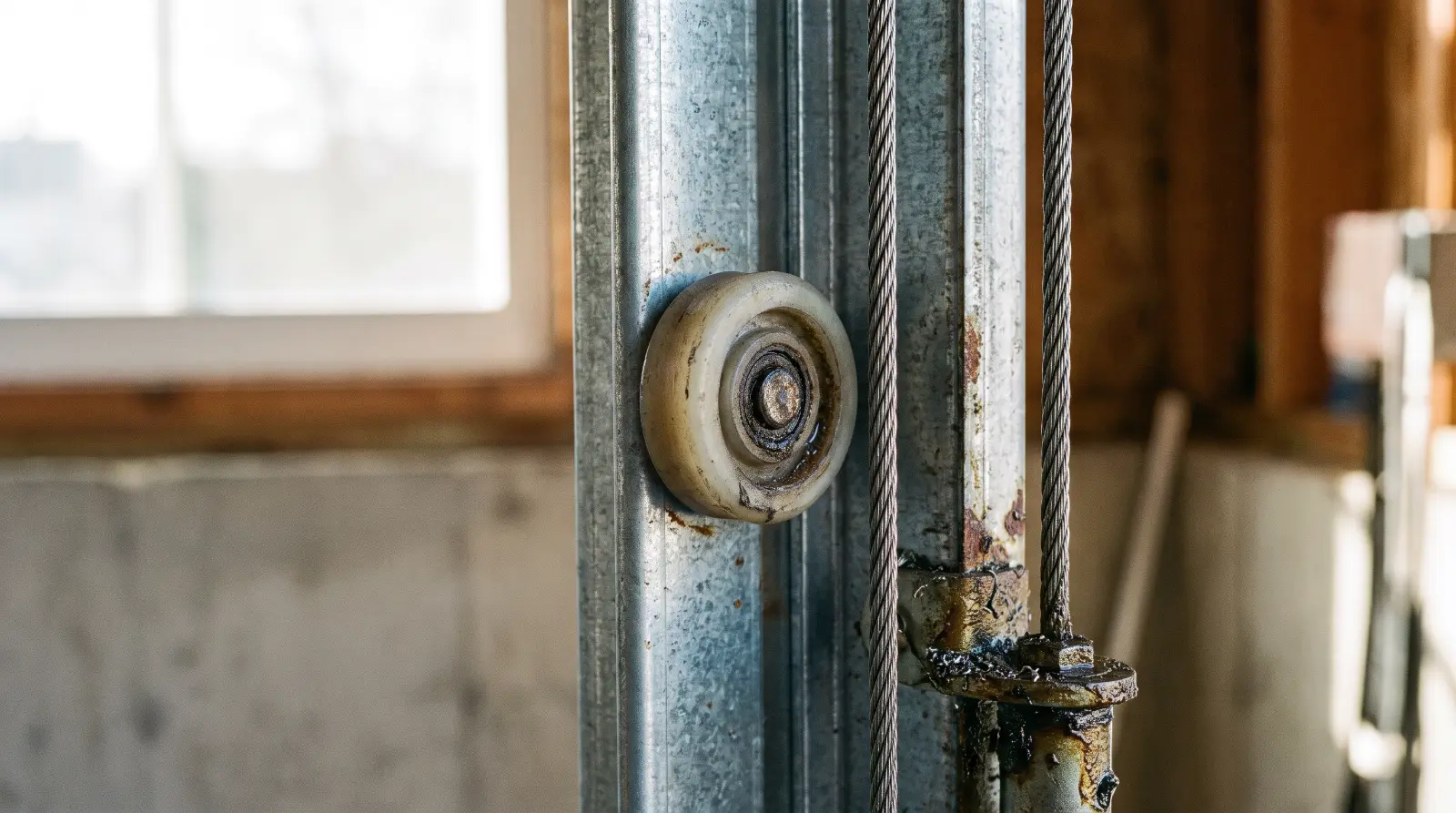
Every sectional garage door hangs from two lift cables, one on each side. Each cable runs from a bracket at the bottom corner of the door up to a drum on the spring bar. When the springs wind and unwind, the drums turn and the cables lift the door evenly. Rollers on the edges of each panel ride in the tracks and keep the door in line. If any one of those pieces fails, the door goes crooked.
Stop using the door if it's hanging lower on one side, if a cable is loose or off its drum, or if a roller has popped out of the track. The door can fall or twist out of the opening. Keep people and cars clear and call.
Signs of a cable or track problem
- One side of the door sits lower than the other, or the door has a visible gap at the floor on one end.
- A cable is hanging slack beside the door or has come off the drum at the top.
- Frayed or rusty strands on the cable, especially near the bottom bracket.
- A roller sitting outside the track, or a track that's bent or pulled away from the wall.
- The door jerks, shudders or binds at the same point every time.
Why cables come off
A spring broke
When a torsion spring breaks, the cable on that side can lose tension and unwind from its drum. That's why a broken spring and a loose cable often show up together. See our spring repair guide.
The bottom bracket rusted or pulled loose
The cable attaches to a bracket at the bottom corner of the door, right where meltwater, road salt and puddles sit. In Cranston's damp coastal air those brackets rust from the floor up. Once one weakens or tears, the cable lets go. Read more in our salt air and rust guide.
The door hit something
A car bumper, a snowblower or a door closing on a bin can knock a section out of line, bend a track, or pop rollers out. One side then binds and the cable on the other side goes slack.
The door was frozen down
If one side of the bottom seal is frozen to the floor and the opener runs, the free side lifts and the stuck side doesn't. The cable on the stuck side can spool off its drum. It's one of the most common winter calls after a nor'easter.
Door hanging crooked or a cable loose? Don't run it. Call.
Call (401) 498-DOORRollers
Most older Cranston doors have steel rollers. Steel rollers are durable, but near the water they rust, their bearings dry out, and they start to grind and bind. Nylon rollers with sealed bearings are quieter and handle damp conditions better. If your door is loud and you're replacing cables anyway, it's reasonable to ask about rollers at the same visit.
Replacing rollers on the bottom section involves the bottom bracket, which is under cable tension. That part is a technician's job. Lubricating rollers that are already in the track is something you can do yourself with a garage door lubricant, not grease.
Tracks
Tracks get bent by cars, by snowblowers, and by doors forced up crooked. A slightly bent track can sometimes be straightened. A badly bent or kinked one usually needs replacing. Track brackets that have pulled out of old wood framing, which happens in some older detached garages where the jambs have softened from moisture, need to be reattached into solid wood.
It's tempting to tap a bent track back with a hammer. Don't, if the door is crooked or a cable is slack. The track may be the only thing holding that side of the door up.
What a technician will usually do
- Secure the door so it can't drop, often with clamps or locking pliers on the track.
- Find the cause: broken spring, failed bracket, bent track, or a cable that jumped off its drum.
- Replace damaged cables in pairs, so both sides wear evenly, and replace rusted bottom brackets if needed.
- Rehang the door square in the opening, set the cables evenly on both drums, and rebalance the springs.
- Run the door through several cycles and test the opener's reverse function.
Most of these repairs take an hour or two. If a section of the door itself is cracked or folded, the conversation may turn to repair or replace.
Common questions
Is it safe to use my garage door with a loose cable?
No. A loose or broken cable means one side of the door has lost its support. It can drop or twist out of the tracks. Stop using it and keep clear until it's repaired.
Should both cables be replaced?
Usually, yes. Cables are the same age and have carried the same load. Replacing both keeps the door lifting evenly. Ask the technician what they recommend.
Can I put a roller back in the track myself?
If the door is crooked or a cable is slack, no. Those parts are under tension. If a single roller has popped out on a door that's otherwise level and balanced, it's still safest to have a technician look, because the cause usually needs fixing too.
Why did my cable come off after a snowstorm?
Most often the bottom seal froze to the floor on one side. When the opener ran, the free side lifted and the frozen side didn't, so the cable on that side spooled off its drum.